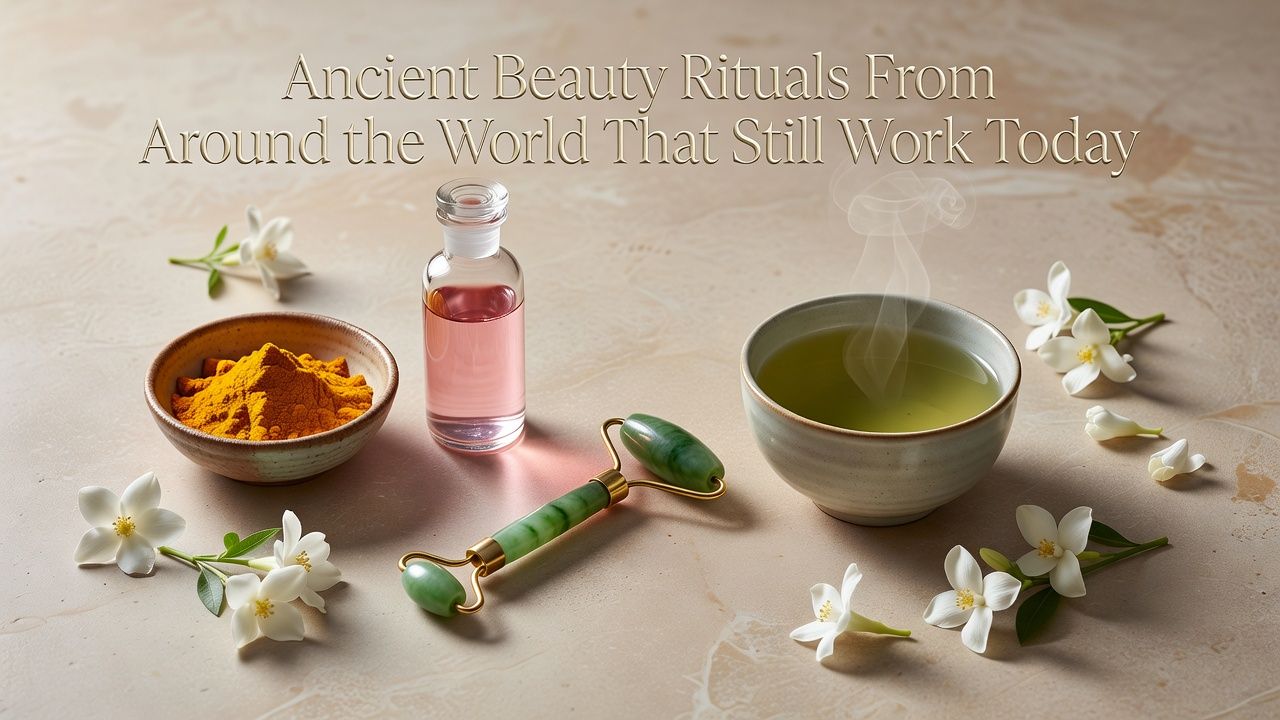
Beauty & Self-Care
Before serums had marketing departments, beauty knowledge traveled through grandmothers. Some of it was folklore. A surprising amount was chemistry — and modern research keeps validating the classics.
Every few months, the beauty industry announces a revolutionary discovery that turns out, on inspection, to be someone’s great-grandmother’s routine with a new label and a dropper bottle. Oil cleansing was the rage of the 2010s; Japanese and Korean women had been dissolving the day with camellia oil for centuries, and Roman bathers scraped olive oil from their skin with bronze strigils two millennia before that. Gua sha tools colonized social media a few years ago; the practice descends from traditional Chinese medicine’s long history of facial massage. Slugging — sealing skin overnight with an occlusive balm — is a viral trend and also, functionally, what people across cold climates have done with animal fats and beeswax since antiquity. The wheel keeps being reinvented because the original wheel worked.
This isn’t to say every ancient practice deserves your face. History also gave us lead-based Venetian ceruse that poisoned Renaissance noblewomen, and plenty of traditional recipes that survive on nostalgia rather than merit — so this tour applies a filter: rituals with genuine longevity across generations and at least plausible or demonstrated mechanisms by modern lights, with honest notes where the evidence is thin. Along the way you’ll notice a pattern worth more than any single recipe: the ancients had no actives to speak of, so their genius went into method — massage, heat, oils, rhythm, ritual — the exact dimension modern routines, obsessed with ingredients, tend to neglect. The old world’s beauty secret wasn’t a substance. It was attention.
East Asia: rice, camellia, and the art of massage
Few beauty legends are as photogenic as the Yao women of Huangluo in southern China, whose famously floor-length black hair is traditionally washed with fermented rice water — a practice echoed by Heian-era Japanese court ladies a thousand years ago. The modern verdict is kinder than skeptics expected: rice water contains inositol and starches that can coat and smooth the hair shaft, and cosmetic-science interest in fermented rice ingredients is genuine, even if the dramatic length claims owe as much to genetics, protective styling, and never bleaching. As a cheap weekly rinse, it’s low-risk and pleasant. Japan’s deeper gift to the canon is tsubaki — camellia oil — pressed for centuries for skin and hair; it’s rich in oleic acid, absorbs elegantly, and remains one of the loveliest simple face and hair oils money can buy, no reformulation required.
China’s most durable export, though, is technique: gua sha and facial massage traditions rooted in centuries of practice. Strip away the mystical marketing and a real mechanism remains — gentle, directional massage moves lymphatic fluid and boosts temporary circulation, which visibly de-puffs a morning face; small studies on facial massage devices suggest modest, real effects on puffiness and perceived firmness with consistent use. The honest frame: gua sha will not “sculpt bone” or replace a retinoid, and it absolutely will make a puffy face look fresher in five minutes while feeling wonderful — which is more than can be said for several forty-dollar serums. Technique matters (light pressure, oiled skin, strokes outward and downward toward the collarbone), and the ritual’s daily minute of self-touch is its own quiet therapy.
South Asia: Ayurveda’s oils, turmeric, and the pre-wedding glow
India’s Ayurvedic tradition treats beauty as a byproduct of routine, and its two most exportable rituals hold up well. The first is abhyanga, the practice of full-body self-massage with warm oil — classically sesame, also coconut in the south — before bathing. Modern dermatology agrees on the parts that matter: oils like coconut are well-studied emollients (coconut oil in particular has clinical support for improving dryness and even mild eczema in some studies), massage itself reduces stress hormones, and applying oil before water cleverly protects skin from the stripping effect of hot showers. The second is hair oiling — oil massaged into scalp and lengths hours before washing — a practice generations of Indian grandmothers enforced and trichologists now politely endorse: coconut oil demonstrably penetrates the hair shaft and reduces protein loss, making the pre-wash oil one of the rare traditional treatments with direct laboratory validation.
Then there is turmeric, star of the haldi ceremony in which brides and grooms are anointed with a golden paste before the wedding — part blessing, part glow treatment. The science is two-sided: curcumin, turmeric’s active compound, has well-documented anti-inflammatory and antioxidant activity, and small clinical studies of topical turmeric preparations show promise for brightness and certain skin conditions, a literature you can explore through the National Center for Complementary and Integrative Health. The practical side: kitchen turmeric stains skin comprehensively yellow and sensitizes some people, so tradition already solved this — ceremonial pastes use kasturi turmeric, a non-staining cosmetic variety, mixed with chickpea flour and yogurt or milk (whose lactic acid adds a gentle exfoliating logic of its own). A weekly ubtan-style mask along those lines is one of the ancient world’s better-value facials.
The Middle East & North Africa: the hammam, black soap, and argan
If one ancient institution deserves revival above all others, it’s the hammam — the communal steam bath descended from Roman thermae through the Islamic world, still thriving from Istanbul to Marrakech. The Moroccan sequence is a complete exfoliation science in ritual form: steam softens the stratum corneum, beldi black soap (a buttery olive-oil soap) is left to further loosen dead cells, and then the kessa glove scrubs it all away in gray rolls that first-timers photograph with horrified delight, finishing with rhassoul — a mineral-rich Atlas Mountains clay used for centuries on skin and hair. Every step has a mechanism a formulator would recognize (heat, surfactant, mechanical exfoliation, absorbent clay), the results are immediate, and the weekly rhythm is exactly the frequency modern dermatology recommends for vigorous exfoliation — tradition arrived at the right dose without a single clinical trial.
From the same region come two anointments with modern résumés. Argan oil, pressed from the nuts of a tree that grows almost exclusively in Morocco and traditionally produced by women’s cooperatives, is rich in vitamin E and fatty acids; published studies associate its use with improved skin hydration and elasticity, and it has earned its place on hair as a finishing oil honestly. And kohl, the eye-liner of ancient Egypt and the region ever since, carries the tour’s necessary warning label: traditional kohl formulations frequently contain lead sulfide, and the FDA maintains import alerts against them — a perfect illustration that “ancient” guarantees nothing by itself. The look survives safely in modern regulated eyeliners; the original recipe belongs in museums.
| Ritual | Origin | What modern evidence says | Verdict |
|---|---|---|---|
| Pre-wash hair oiling (coconut) | South Asia | Lab-verified: penetrates hair, reduces protein loss | Strongly supported |
| Hammam exfoliation sequence | North Africa / Levant | Sound mechanisms; sensible weekly dose | Supported |
| Oil cleansing / anointing | Rome, East Asia, Ayurveda | “Like dissolves like” — gentle, effective makeup/SPF removal | Supported |
| Honey masks | Egypt, Greece, widespread | Humectant + documented antibacterial properties (esp. medical-grade honey) | Supported |
| Gua sha / facial massage | China | Real short-term de-puffing; sculpting claims overstated | Modestly supported |
| Rice water rinses | China, Japan | Plausible smoothing; grand claims unproven | Harmless, promising |
| Traditional kohl; lead/mercury cosmetics | Various | Documented heavy-metal toxicity; FDA import alerts | Avoid — use modern versions |
The Mediterranean and the North: olive, honey, and heat
The Mediterranean’s contribution is elegantly minimal: olive oil and honey, the two ingredients Cleopatra’s legend and Greek practice share. Honey earns its keep by chemistry — it’s a natural humectant with genuinely documented antibacterial properties (medical-grade honey is used in modern wound care), which makes the classic fifteen-minute honey mask one of the few kitchen treatments a dermatologist won’t roll their eyes at. Olive oil anointing, the Greco-Roman full-body routine, survives as sound advice in modified form: rich plant oils remain excellent body emollients, though facial skin, especially acne-prone, often prefers lighter modern oils — and the strigil’s descendant is simply exfoliation plus oil, the hammam’s logic in a toga. Milk baths, the other Cleopatra signature, rest on real chemistry too: lactic acid is a gentle alpha-hydroxy exfoliant that modern formulators bottle at proper concentrations for exactly the softening effect the legend promised.
Head north and the ritual is heat itself. The Finnish sauna — and its cousins, the Russian banya with its birch-branch venik massage and the sweat-bathing traditions of many indigenous cultures — approaches skin from the inside: circulation surges, sweat flows, and the cold plunge after trains the blood vessels like a gymnasium. The broader health literature on regular sauna use, much of it from Finland where the practice is near-universal, associates it with cardiovascular benefits, and the post-sauna glow is the visible edge of that circulation story; overviews of the research are accessible through resources like Harvard Health. The skin-specific rules the tradition already encodes — hydrate generously, moisturize after, and those with certain skin or heart conditions should check with a doctor first — are the same ones a dermatologist would append today.
Bringing the old world into your week — without the hype
The practical harvest from all this history fits into an ordinary modern life with almost no shopping. A weekly ritual evening covers most of it: a steamy shower standing in for the hammam, an oil pre-cleanse in the East Asian manner, a honey or yogurt-based mask from the Mediterranean-Ayurvedic songbook, and five minutes of unhurried facial massage — thumbs, knuckles, or a gua sha tool, pressure light, strokes outward — while the mask sits. Hair gets the South Asian treatment the same night: oil massaged in an hour before washing. Total cost, once the pantry is stocked: pocket change. Total time: under an hour that doubles as the week’s most reliable decompression — because the second thing every one of these traditions encodes, beneath the recipes, is scheduled, unhurried self-care as a norm rather than an indulgence, the cultural technology modern beauty quietly abandoned when it optimized everything down to a sixty-second routine.
Keep three honest guardrails and the ancients will serve you well. First, tradition complements but never replaces the proven modern core — no amount of rice water substitutes for daily sunscreen, and grandmothers across every one of these cultures practiced sun avoidance more diligently than their descendants. Second, natural is not automatically gentle: patch test kitchen ingredients like anything else, keep undiluted essential oils and staining turmeric off your face, and leave lead kohl and mercury “brighteners” to the archaeologists. Third, respect the source — many of these practices are living culture, not aesthetic props, and the best versions of them (argan from women’s cooperatives, gua sha learned properly, a real hammam visited on its own terms) come with their context attached. Do that, and what you inherit isn’t a trend cycle’s worth of hacks. It’s several thousand years of quality-tested attention — the one beauty ingredient that has never once been reformulated.