Home & Lifestyle
The Danes are among the happiest people on earth, and they credit a word that barely translates. Hygge isn’t candles and blankets for sale — it’s a whole philosophy of everyday contentment.
Denmark spends much of the year cold, grey, and dark — in deep winter, daylight can be a brief afternoon interlude — and yet Danes consistently rank among the happiest people in the world in international surveys. When asked to explain this apparent paradox, they reach for a word that doesn’t quite translate into English: hygge (roughly “HOO-gah”). Often rendered as “coziness,” hygge is really something larger — a quality of presence, warmth, and contentment in simple, everyday moments, usually shared with others, that has become central to Danish culture and, many believe, to Danish wellbeing. In the mid-2010s the concept swept the English-speaking world as a lifestyle trend, and in the process got somewhat flattened into an aesthetic of fuzzy socks and expensive candles. The real thing is deeper, cheaper, and considerably more useful.
This matters beyond seasonal decor because hygge offers a genuine philosophy of happiness — one grounded not in achievement, acquisition, or peak experiences but in savoring the ordinary, present moment. In a culture that often chases happiness through the next purchase or milestone, the Danish approach of finding deep contentment in a warm drink, good company, and a comfortable evening is quietly radical, and its emphasis on presence, connection, and simple pleasures aligns strikingly well with what happiness research actually finds drives wellbeing. Denmark’s consistent showing near the top of the World Happiness Report has made the world curious about what the Danes know. This guide covers what hygge genuinely is (and isn’t), how to create it in your home and daily life, and why its underlying philosophy is worth adopting regardless of whether you ever light a candle.
What hygge really means
At its core, hygge is a feeling — of coziness, warmth, safety, contentment, and connection — typically arising in simple, present-focused moments, often but not always shared with people you care about. Picture a candlelit dinner with close friends where no one is rushing, a solitary evening with tea and a book under a blanket while rain falls outside, a slow weekend breakfast that stretches unhurried, friends gathered around a fire. The common threads are presence (being fully in the moment rather than distracted or elsewhere), warmth (both literal and emotional), simplicity (ordinary pleasures, not grand events), and very often togetherness, since hygge is frequently a social experience of easy, comfortable connection. It is contentment in the here and now, deliberately noticed and enjoyed.
It’s just as important to understand what hygge is not, because the commercialized version gets this backwards. Hygge is not about buying things — the trend spawned countless products, but authentic hygge is inexpensive or free, found in atmosphere and presence rather than purchases, and a candle helps only insofar as it creates a mood you actually inhabit. It is not luxury or perfection; it’s humble and unpretentious, and a chipped mug of cocoa in a messy-but-cozy room is more hygge than a flawless, expensive tableau. And it isn’t only for winter or only solitary — while strongly associated with cold, dark seasons (its power partly lies in creating warmth and light against the dark), hygge exists year-round, and while often social, it can absolutely be enjoyed alone. Strip away the marketing and what remains is the genuinely valuable core: intentionally creating and savoring cozy, contented, connected moments in everyday life.
Creating a hyggeligt home
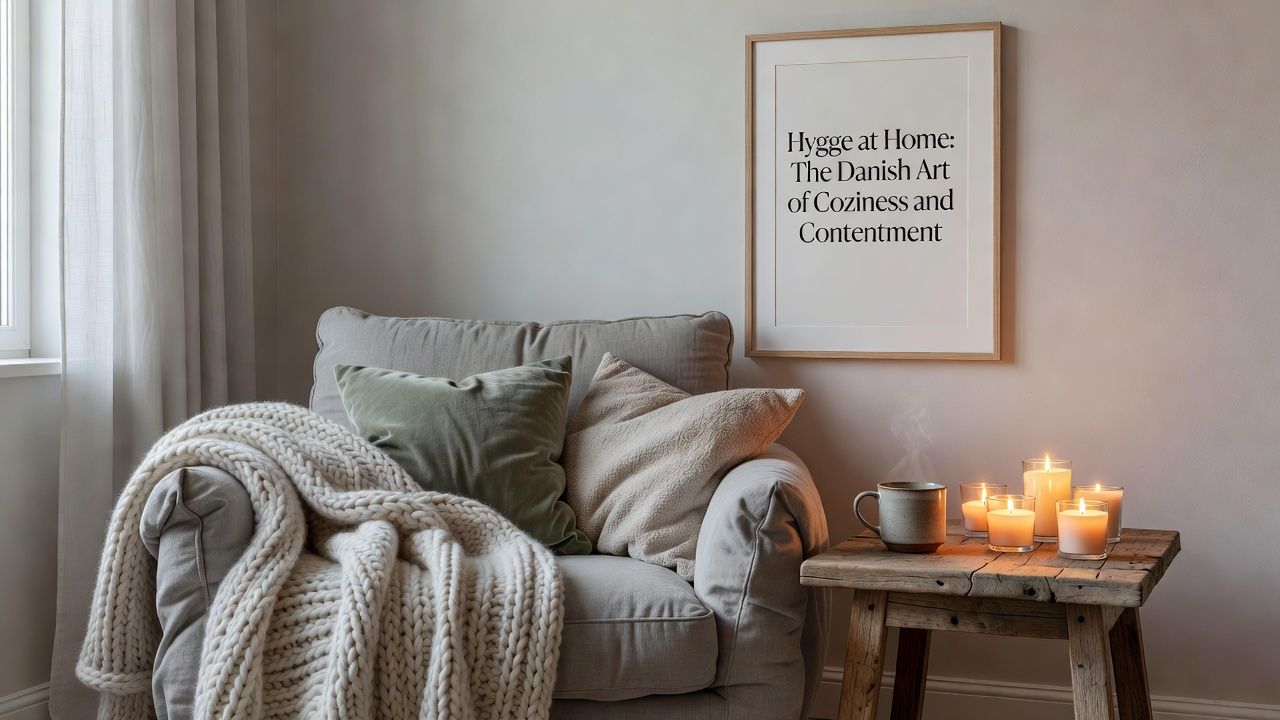
While hygge is ultimately a feeling, the physical environment strongly supports it, and a hyggeligt (hygge-like) home is built from a few sensory elements — none of which need be expensive. Lighting is the most essential: Danes are famous for their devotion to soft, warm, low lighting, especially candles (they burn more candles per person than almost anyone), because gentle warm light is deeply calming and creates instant atmosphere, while harsh overhead light is the enemy of coziness. Beyond that, hygge lives in soft, warm textures (blankets, cushions, throws, wool, cozy socks — things that invite touch and nesting), in natural materials (wood, warm textiles, natural elements that feel grounding), and in warmth both literal (a fire, a heater, a warm drink) and emotional. The aim is a space that feels safe, soft, and inviting to settle into.
| Element | How to bring it in | Cost |
|---|---|---|
| Soft warm light | Candles, lamps with warm bulbs, string lights; switch off the harsh overhead | Low |
| Soft textures | Blankets, cushions, throws, wool socks — things you want to burrow into | Low (thrift it) |
| Warm drinks & comfort food | Tea, cocoa, coffee, mulled drinks; simple baking that scents the home | Low |
| Natural materials | Wood, wool, cotton, a few plants or natural touches | Low–free |
| A cozy nook | A designated comfortable corner for reading, tea, resting | Free |
| Presence (the real ingredient) | Screens away; being genuinely in the moment and with your company | Free |
Food and drink are woven through hygge — warm beverages, comfort food, and homemade treats are classic components, less about indulgence than about the ritual and warmth they provide, and the act of baking something that fills the home with scent is itself deeply hygge. But the table’s final row is the one that matters most: presence is the true ingredient, and all the props are just supports. You can assemble every candle and blanket in the catalog and feel nothing if your mind is elsewhere and your phone is in your hand. Equally, a bare room can be profoundly hygge if you’re fully present, warm, and content in it. The atmosphere sets the stage; being in the moment is the actual experience.
Hygge as a practice, not just a look
Beyond decor, hygge is something you do — a set of activities and, more importantly, a way of being present within them. The classic hygge activities are unglamorous and available to nearly everyone: reading under a blanket, cooking and sharing a slow meal, board games with friends, a long conversation over coffee, watching rain from a warm window, an unhurried bath. What transforms these ordinary activities into hygge is how you do them — slowly, without rushing, fully present, savoring the moment rather than half-attending while planning the next thing. This is where hygge connects directly to mindfulness: both are fundamentally about being here, now, and appreciating the present rather than living in the anxious future or the regretful past.
The social dimension deserves emphasis because hygge is so often shared, and here it aligns with one of the most robust findings in all of wellbeing science. Cozy gatherings with people you’re comfortable with — the easy, unpretentious kind where you can fully relax, not the performative dinner party — are quintessentially hygge, and strong social connection is repeatedly identified by happiness researchers, in work collected at places like the Greater Good Science Center, as among the strongest predictors of happiness and even physical health. Hygge, in this light, isn’t just a pleasant mood; it’s a cultural practice that reliably generates the warm, present, connected experiences that genuinely make human beings happy. That’s a large part of why a small, dark, cold country keeps topping the happiness charts — it has institutionalized the deliberate creation of contentment.
The philosophy underneath
What makes hygge worth more than a decorating trend is the philosophy of happiness embedded in it. Modern culture often frames happiness as something to be achieved — through success, wealth, milestones, extraordinary experiences — always somewhere ahead, contingent on the next accomplishment. Hygge locates happiness somewhere entirely different: in the ordinary present, in simple pleasures noticed and savored, in contentment rather than excitement. This turns out to be a wiser bet than it sounds, because happiness research consistently finds that everyday small positive experiences and strong relationships contribute more to lasting wellbeing than rare peak moments or material acquisitions, and that the deliberate savoring of ordinary pleasures measurably increases happiness. Hygge is, in effect, a folk technology for doing exactly that.
There’s also a quiet cultural value in hygge’s embrace of slowness and imperfection, a gentle counter to the pressure toward constant productivity and optimization. Hygge gives explicit permission to rest, to do nothing much, to be cozy and content without justification — and in an always-on culture, permission to simply be present and comfortable is genuinely valuable. Its unpretentiousness matters too: hygge isn’t about impressive homes or curated perfection but about warmth and comfort that anyone can create, which makes it democratic in a way many wellness trends are not. You don’t need money, space, or a particular aesthetic; you need only the willingness to slow down, warm up, and pay attention to the good ordinary moment you’re in.
Bringing hygge into your life
Adopting hygge doesn’t require becoming Danish or overhauling your home; it requires a shift in attention and a few small, deliberate practices. Start by creating cozy moments intentionally rather than waiting for them: light a candle and make tea on an ordinary evening, put the phone away and read under a blanket, invite a friend over for a low-key, unpretentious hang rather than a performance. Build small hygge rituals into your routine — a warm drink savored slowly each morning, a device-free cozy hour before bed, a standing casual gathering with people you love — and lean into the seasons, using hygge especially to make the cold, dark months something to enjoy rather than merely endure, since creating warmth and light against the dark is where its magic is most potent. Above all, practice presence: whatever cozy moment you create, actually inhabit it, screens away, mind here, savoring rather than rushing.
The deepest takeaway is that hygge reframes where contentment comes from — not from acquiring more or achieving the next thing, but from noticing and savoring the warm, simple, connected moments already available in ordinary life. A candlelit evening, a shared meal, a quiet hour with a book, easy time with people you love: these small pleasures, deliberately created and fully enjoyed, are a genuine and reliable source of happiness, and one entirely within reach whatever your circumstances. That is the real gift the Danes are offering the rest of us — not a product line or an aesthetic, but a wiser and gentler answer to the question of how to be happy. Light the candle, make the tea, put the phone in another room, and be fully, warmly, contentedly here. That’s the whole of it, and it’s enough.