Home & Lifestyle
A calming space isn’t about money or square footage — it’s about how a room meets your senses. Here’s the psychology of restful spaces, and how to build one wherever you live.
Everyone recognizes the feeling of a space that calms them — and the opposite, the room that quietly winds you tighter without your quite knowing why. We tend to treat this as taste or luck, but it’s neither: our surroundings measurably affect our nervous systems, and the reasons a space feels peaceful or agitating are surprisingly well understood. A growing body of research in environmental psychology shows that light, color, clutter, nature, sound, and sensory texture all shape our stress levels, mood, and even physiology, often below conscious awareness. This is genuinely good news, because it means a restful space isn’t a matter of expensive design or a big budget — it’s a matter of understanding a handful of principles and applying them to whatever room, and whatever means, you actually have.
A home sanctuary matters more than ever precisely because modern life is so relentlessly stimulating. If your environment is one more source of low-grade stress — visual noise, harsh light, a to-do list disguised as a living room — you never fully downshift, even at home. Creating a genuine retreat, whether a whole room or just a corner, gives your nervous system a reliable place to recover, and the effects ripple outward into sleep, mood, and resilience. This guide covers the psychology of calming spaces and how to apply it: light, color, decluttering, nature, sound and scent, and the crucial idea of a dedicated retreat zone — all achievable in a rental, on a budget, in a small space. Design and wellbeing organizations increasingly treat this seriously; resources on healthy, restorative environments are available through groups like the World Health Organization and design-and-health researchers.
Start with light: the single biggest lever
If you change only one thing, change the light, because nothing shapes a room’s feeling and your body’s state more powerfully. Natural daylight is the ideal — it regulates your circadian rhythm, lifts mood, and simply makes spaces feel alive — so the first move in any room is to maximize it: pull furniture away from windows, swap heavy drapes for light-filtering options, keep glass clean, and use mirrors to bounce daylight deeper into the space. Exposure to natural light is tied to better sleep and mood, a connection health bodies like the CDC underline, so treating your windows as an asset to be uncovered rather than dressed over is foundational.
Artificial light is where most homes go wrong, and where the easiest wins live. The enemy of a restful space is a single harsh overhead light — the “big light” — casting flat, cool, shadowless glare over everything. The fix is layering: several smaller, warmer sources at different heights (a table lamp, a floor lamp, a corner light) create pools of soft light that read as cozy and calm rather than clinical. Warm-toned bulbs matter enormously in living and resting spaces, and dimmers — even inexpensive plug-in or smart-bulb versions — let a room shift from functional daytime to restful evening. In the hours before sleep especially, dimmer and warmer wins, working with your biology instead of against it. This is a small, cheap change with an outsized effect on how a room feels.
Color, clutter, and the calm palette
Color carries real psychological weight, and while personal association matters (the research here is suggestive rather than absolute), some broad tendencies hold. Soft, muted, cooler and earthy tones — gentle blues, greens, warm neutrals, dusty and muted shades — tend to read as calming, while highly saturated, high-contrast, or very warm bright colors are more stimulating and better suited to energizing spaces than restful ones. You don’t need to repaint to use this: a calm foundation of muted walls and larger pieces, with color introduced through easily-changed textiles, art, and accents, gives you both serenity and personality. In rentals where painting isn’t allowed, you’re working with textiles, throws, cushions, and art anyway — which is plenty, because these soft elements carry much of a room’s emotional tone.
Clutter deserves its own attention, because visual chaos is one of the most direct assaults on a room’s peace. Research has linked cluttered, disorganized home environments to higher levels of the stress hormone cortisol, and the mechanism is intuitive: a cluttered space bombards you with visual information and silent unfinished tasks, keeping the mind subtly activated. A calm room is, above almost everything else, an uncluttered one — which doesn’t mean stark or minimalist by taste, but ordered, with surfaces mostly clear and belongings having homes. The single highest-impact intervention for most people isn’t buying anything; it’s clearing the visual noise from the surfaces and floor of the space they want to feel peaceful. Storage that hides rather than displays, and the discipline of clear surfaces, do more for calm than any decorative purchase.
| Element | Tends to calm | Tends to stimulate |
|---|---|---|
| Light | Natural daylight; warm, layered lamps; dimmable | Single harsh overhead; cool, bright glare |
| Color | Muted, earthy, cooler tones; soft neutrals | Highly saturated, high-contrast, hot brights |
| Surfaces | Clear, ordered, things with homes | Cluttered, piled, visually busy |
| Texture | Soft, natural, layered (wood, linen, wool) | Hard, cold, uniform, plastic-heavy |
| Nature | Plants, natural materials, a view, natural light | Sealed, sterile, entirely synthetic |
| Sound | Quiet, soft furnishings that absorb noise, gentle audio | Echoey hard surfaces, background TV, notifications |
Bring in nature: the biophilia effect
One of the most robust findings in environmental psychology is that humans are calmed by nature — a tendency researchers call biophilia. Exposure to natural elements, even indoors or in images, is associated with reduced stress and improved mood and attention, which is why bringing nature into a space is such a reliable path to calm. The most direct route is houseplants, which add life, soften hard lines, and connect a room to the natural world; choosing hardy, low-maintenance varieties means the calm doesn’t come with a side of plant-keeping anxiety. Beyond plants, natural materials do quiet work — wood, stone, rattan, linen, wool, and cotton bring warmth and organic texture that synthetic, uniform surfaces lack, and layering these soft natural textures is one of the surest ways to make a space feel restful and inviting.
Nature also enters through the senses beyond sight. Natural light, already discussed, is itself a biophilic element. A view of greenery, if you have one, is worth arranging your seating around; where you don’t, nature imagery, natural materials, and even the sound of water or birdsong can substitute meaningfully. The broader principle — increasingly used in the field of biophilic design, which the wellbeing-focused design community explores through resources like the U.S. Green Building Council — is that our nervous systems evolved in nature and relax when reminded of it. You don’t need a garden or a forest view; a few plants, some natural materials, and daylight together deliver most of the effect, in an apartment as much as a house.
The forgotten senses: sound and scent
Most people design for the eyes and forget that a sanctuary is a full-sensory experience — and sound is the most neglected dimension. Unwanted noise is a genuine, physiological stressor: chronic noise exposure is associated with elevated stress and disrupted sleep, and even low-level background noise you’ve stopped consciously noticing keeps the nervous system subtly alert. A restful space is a quiet one, so managing sound matters — soft furnishings (rugs, curtains, upholstered pieces, cushions) absorb sound and tame the harsh echo of hard-surfaced rooms, which is part of why a textile-rich room simply feels calmer. Beyond reducing unwanted noise, you can add restful sound deliberately: gentle music, nature sounds, or a small water feature, and white or brown noise to mask disruptive background sound, especially for sleep. The World Health Organization treats environmental noise as a real health issue, which is worth remembering when a space feels stressful for no visible reason — the reason may be audible.
Scent is the other overlooked sense, and a powerful one because smell connects directly to the brain’s emotional and memory centers, making it unusually effective at shifting mood and marking a space as restful. A consistent, pleasant scent — whether from essential oils, candles, incense, fresh flowers, or simmering herbs — can become a cue that tells your nervous system “this is the calm place,” and certain scents like lavender are traditionally associated with relaxation. A few sensible cautions keep this safe and pleasant: ventilate, keep scents subtle rather than overpowering, be mindful of allergies and sensitivities (and of pets, since some essential oils are not safe around animals), and follow basic fire safety with candles and incense. Used thoughtfully, scent is one of the fastest and most evocative ways to transform how a room feels — an invisible but potent layer of the sanctuary.
Small spaces, small budgets, and the dedicated retreat
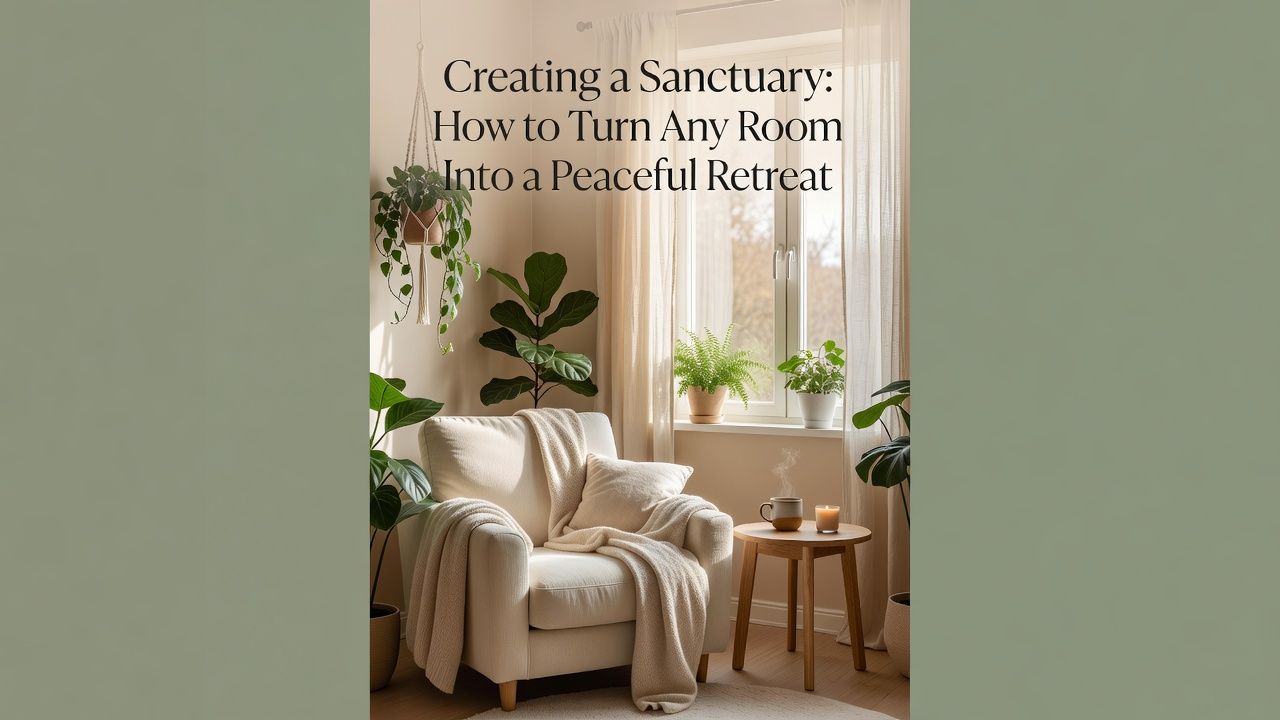
None of this requires a whole room or a renovation, and that’s the point worth insisting on. You can create a sanctuary in a single corner — a comfortable chair by a window, a soft throw, a plant, a lamp, and a small table for tea or a book — a defined nook that signals rest even in a busy, shared, or tiny home. What makes it work is intention and boundary: a spot reserved for calm and, ideally, kept free of work and screens, so that being there becomes a reliable cue to downshift. Even in the smallest apartment, one such zone gives the nervous system somewhere dependable to recover, and the ritual of retreating to it — a morning coffee, an evening wind-down — matters as much as its contents.
Budget and rental limitations are real but far less restrictive than people assume, because the biggest levers are cheap or free: decluttering costs nothing, rearranging furniture to face light or a view costs nothing, and swapping harsh bulbs for warm ones or adding a thrifted lamp costs very little. Textiles, plants, and secondhand finds do most of the decorative work at modest cost, and everything here is removable and renter-friendly — no paint or permanent changes required. The mindset that unlocks it all is treating your space as an active contributor to your wellbeing rather than a neutral backdrop: a room can either drain you or restore you, and the difference lies mostly in these accessible, low-cost principles. Start with one — the harsh overhead light, the cluttered surface, the corner that could hold a chair and a plant — and build your retreat one small, deliberate change at a time. A sanctuary isn’t bought; it’s arranged, out of what you already have, around the simple knowledge of what actually helps a nervous system rest.