Health & Nutrition
Strawberries in December and asparagus in October — the modern supermarket erased the seasons. Bringing them back is one of the simplest upgrades available to your plate, your wallet, and your planet.
For almost all of human history, you ate what was ripe. There was no other option: spring meant tender greens and the first peas, summer brought a flood of berries and stone fruit, autumn delivered squash and apples and roots, and winter meant stored grains, preserved foods, and hardy brassicas. The calendar and the plate were the same document. Then, in a few generations, global supply chains, refrigeration, and industrial agriculture severed that connection so completely that most people under fifty have never experienced it. Today the supermarket offers every fruit and vegetable every day of the year, flown in from wherever it happens to be summer, and a child can grow up genuinely unaware that a strawberry has a season at all. This is a genuine marvel of logistics — and a quiet loss whose costs we’re only beginning to add up.
Seasonal eating simply means choosing more of your food from what’s naturally in season and grown reasonably nearby, rather than defaulting to the year-round global average. It’s not a rigid diet or a purity test — nobody’s asking you to forgo bananas or feel guilty about frozen peas — but a gentle reorientation with a surprising stack of benefits: better flavor and nutrition, lower cost, a lighter environmental footprint, and a richer, more connected relationship with food. It also happens to naturally produce the varied, plant-forward, whole-food diet that nutrition science keeps recommending, since eating with the seasons forces variety in a way a fixed shopping list never does. Organizations from the USDA to environmental groups have quietly championed the practice, and it’s one of the rare wellness ideas where flavor, health, thrift, and sustainability all point the same direction.
Flavor and nutrition: why in-season produce is simply better
Anyone who has tasted a real summer tomato and then a pale winter one knows the flavor argument without needing a study. The reason is straightforward: produce grown in its natural season, in appropriate conditions, and harvested closer to ripeness develops more sugars, acids, and aromatic compounds than fruit picked hard and green to survive a long-distance journey and ripened artificially in transit. That out-of-season tomato was likely bred for durability and shelf life over taste, harvested weeks before it was ready, and gassed to redness — a process that produces the color of ripeness without its flavor. In-season, local produce skips most of that compromise, which is why the same fruit can taste like two different foods depending on the month you buy it.
The nutrition angle is real but worth stating carefully, without overselling. Many nutrients — particularly sensitive ones like vitamin C and certain antioxidants — degrade over time after harvest and with prolonged storage and transport, so produce that travels a long way and sits in warehouses can lose some nutritional value along the journey; freshly harvested, in-season, local produce often retains more. That said, the honest caveat is that a frozen vegetable picked and flash-frozen at peak ripeness can actually retain nutrients better than a “fresh” one that spent two weeks in transit — so frozen produce is a genuinely excellent, often more nutritious and affordable, ally in seasonal eating, not a compromise. The takeaway isn’t “fresh always wins”; it’s that the long, slow global supply chain has quiet costs to both flavor and nutrition that seasonal and frozen options both sidestep. General guidance on maximizing produce nutrition is available through the Harvard Nutrition Source.
The wallet and the planet
Seasonal eating is one of the few health practices that saves money rather than costing it, thanks to the oldest law in economics. When a crop is in season locally, it’s abundant, and abundance drives prices down — peak-season produce is routinely a fraction of its off-season price, and it’s usually at its best quality exactly when it’s cheapest. Off-season, that same item must be grown in heated greenhouses, shipped across the world, or held in long-term storage, and all of that cost lands in the price. Eating with the seasons therefore means eating better-tasting, often more nutritious food for less — a rare alignment. It also naturally encourages you to buy the affordable, seasonal staples in bulk when they peak and preserve the surplus, an old thrift that connects directly to the next benefit.
The environmental case is significant, if more nuanced than the popular “food miles” slogan suggests. Off-season and long-distance produce can carry a heavier footprint through refrigerated transport, air freight for delicate items, and energy-intensive heated greenhouses. But the research — summarized by environmental bodies like the EPA and sustainability researchers — shows that how and when food is produced usually matters more than the raw distance it traveled; a field-grown vegetable trucked a long way can have a lower footprint than a local one grown in a heated greenhouse out of season. The clean summary: choosing food that’s in season where you are tends to favor the lower-impact production method (open fields in appropriate climate over heated glass or air freight), which is why “seasonal and local” is a better environmental heuristic than “local” alone. It also supports regional farms and shortens the supply chain, benefits that go beyond carbon.
| Benefit | In-season & local | Out-of-season & long-distance |
|---|---|---|
| Flavor | Ripe, full, aromatic | Often picked green, bred for durability |
| Nutrition | Retains more of sensitive nutrients | Some loss over transit & storage |
| Cost | Cheapest at peak abundance | Premium for greenhouse/shipping |
| Environment | Favors lower-impact field growing | Heated greenhouses / air freight add impact |
| Variety | Rotates naturally through the year | Same items year-round; less dietary diversity |
A four-season field guide
Exactly what’s in season depends heavily on your climate and hemisphere — a crucial caveat, since seasonal calendars are always local — but the broad northern-temperate pattern below gives the shape of the year. The single most useful habit is simply learning your own region’s calendar, which local farmers’ markets, agricultural extension services, and seasonal-food websites make easy. Here’s the general rhythm to anchor to:
| Season | Typically at its best | The mood of the plate |
|---|---|---|
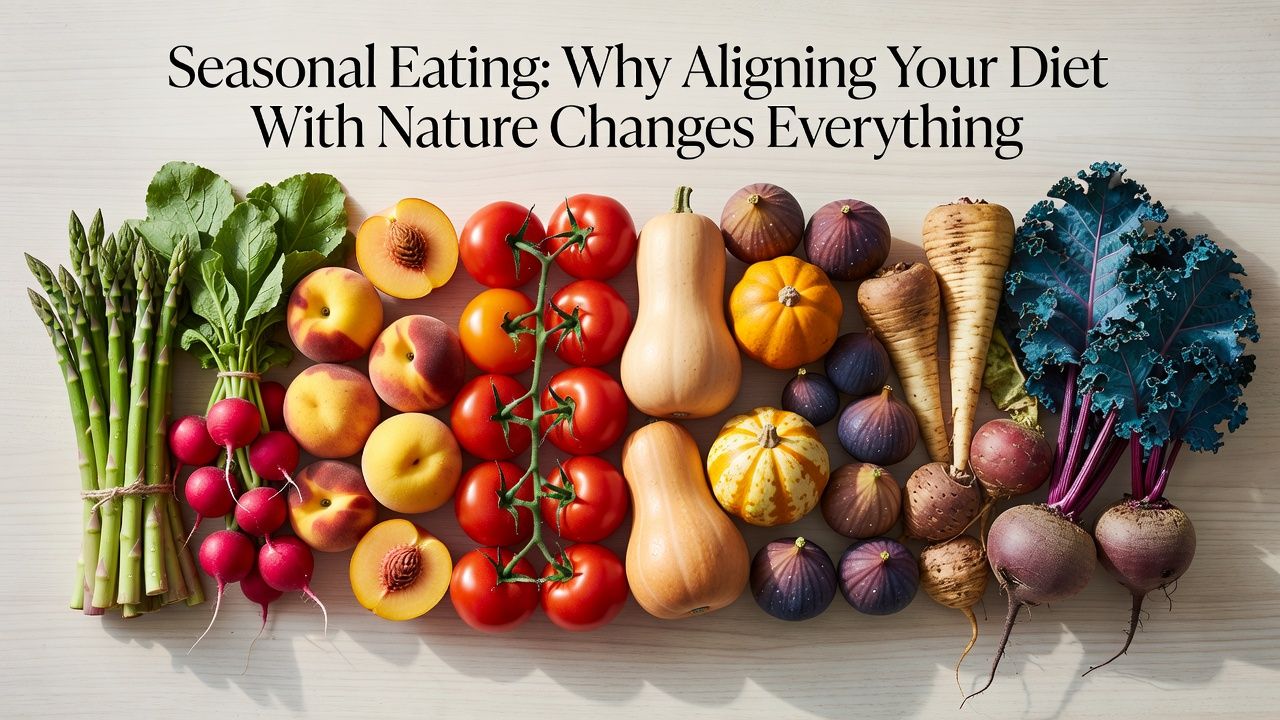
| Spring | Asparagus, peas, radishes, tender greens, rhubarb, spring onions, artichokes | Light, green, fresh — the body’s welcome after heavy winter fare |
| Summer | Tomatoes, berries, stone fruit, corn, zucchini, peppers, cucumbers, melon | Abundance and color — the peak of variety and sweetness |
| Autumn | Squash, pumpkins, apples, pears, root vegetables, brassicas, mushrooms | Warm, earthy, hearty — the harvest and the turn toward comfort |
| Winter | Citrus, cabbage, kale, leeks, stored roots, potatoes, winter squash | Slow, sustaining — soups, braises, and bright citrus against the grey |
There’s a quiet elegance in how this rhythm matches the body’s changing wants: crisp, hydrating produce in summer’s heat; warming roots and squash as the weather turns; bright citrus arriving in deep winter precisely when a vitamin-C lift feels welcome. Traditional food cultures worldwide built their cuisines around exactly these cycles, and many wellness traditions — from various folk practices to systems like Ayurveda and traditional Chinese medicine — formalized the intuition that we should eat cooling foods in heat and warming foods in cold. Modern science doesn’t endorse every specific claim of those systems, but the underlying instinct — that eating in tune with the season feels right — is one most people rediscover the moment they start paying attention.
Making it practical (without becoming a purist)
The fastest on-ramp is the farmers’ market, because by definition it sells you what’s in season and local — you almost can’t get it wrong, and you’ll pick up growers’ knowledge for free. Community-supported agriculture (CSA) boxes go further, delivering a weekly share of the farm’s seasonal harvest and gently forcing you to cook with whatever’s ripe, which is the single best cure for cooking in a rut. But you don’t need either: even a regular supermarket telegraphs the seasons if you learn to read the signals — what’s on prominent sale, what’s abundant and cheap, what suddenly tastes good — and many stores label local produce. The core skill is just shifting your default: instead of arriving with a fixed list and buying whatever version exists year-round, arrive open and build meals around what’s genuinely at its best that week.
Two practices make seasonal eating sustainable rather than restrictive. First, embrace preservation — the traditional answer to seasonality’s central problem. When something peaks (and is cheapest), buy extra and freeze, dry, ferment, or make it into sauces and jams; a summer’s glut of tomatoes becomes winter’s pasta sauce, and freezing berries at their peak beats buying sad imported ones in January. The National Center for Home Food Preservation offers safe, science-based methods for anyone who wants to go beyond the freezer. Second, keep perspective and skip the purism: seasonal eating is a gentle default, not a religion. Keep your bananas and coffee and out-of-season favorites; lean on frozen produce freely; and let seasonality guide roughly rather than rule absolutely. The goal is a plate that rotates with the year — more varied, more flavorful, cheaper, and more connected to where and when your food actually grows — not another set of rules to feel guilty about. Start with one season, one market visit, one meal built around what’s ripe right now, and let the calendar teach you the rest.