Beauty & Self-Care
We wear exhaustion like a medal and treat sleep like a luxury we’ll earn once everything’s done. The science says we’ve got it exactly backwards — and reclaiming rest is quietly radical.
Somewhere we absorbed the idea that sleep is negotiable — the first thing to sacrifice for work, ambition, parenting, or one more episode. We brag about running on four hours, admire the executives who claim to need almost none, and treat “I’m so tired” as evidence of a life fully lived rather than a warning light. This is one of the strangest self-inflicted wounds of modern culture, because on no other topic is the science so overwhelming and so ignored at once. Sleep is not the reward for a productive life; it is the biological precondition for one. During those hours the body isn’t idle — it’s running its most essential maintenance: consolidating memory, clearing metabolic waste from the brain, regulating hormones and appetite, repairing tissue, and resetting the emotional system. Skip it, and every one of those processes degrades the next day.
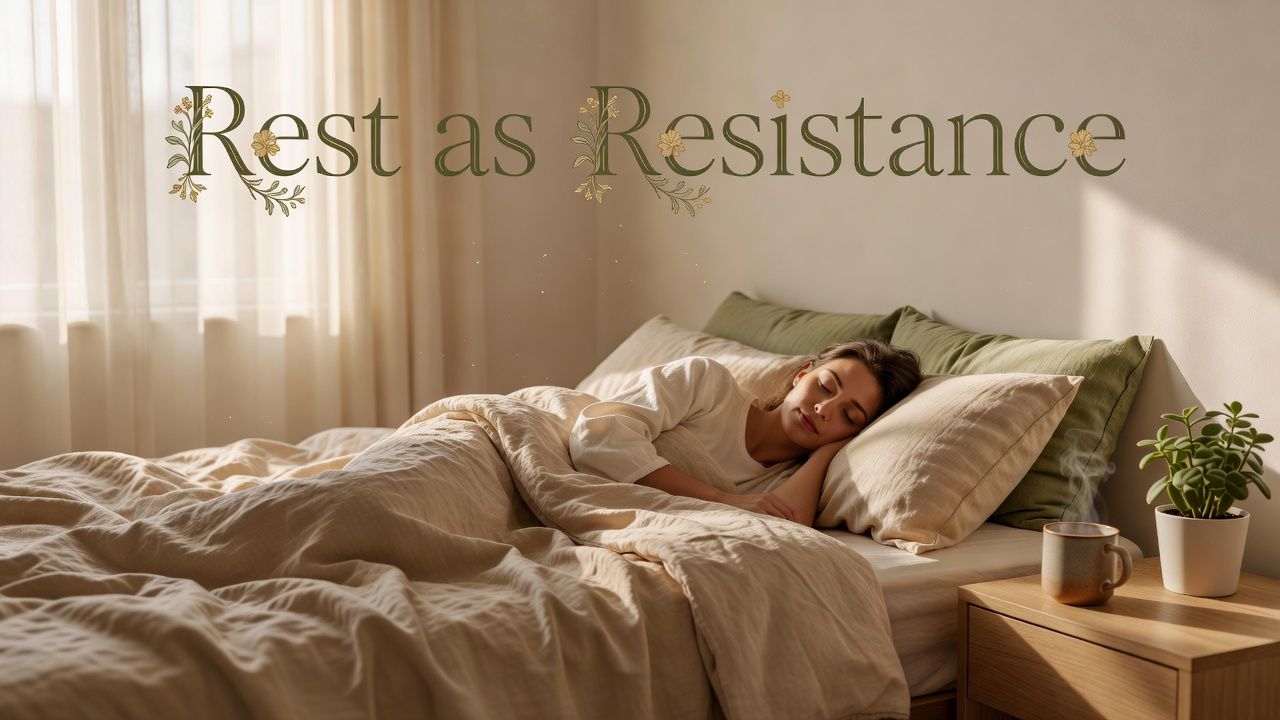
The framing of “rest as resistance” comes from a growing movement pushing back against grind culture — the notion, articulated by rest advocates and increasingly backed by public-health data, that in a world engineered to extract every waking hour, choosing to rest is a countercultural act. And the health case is not soft. The CDC classifies insufficient sleep as a public-health problem, linking chronic short sleep to heightened risk of heart disease, diabetes, obesity, depression, and impaired immunity; sleep research institutes tie it to accidents, poor decisions, and shortened lifespan. This isn’t an article nagging you toward another optimization. It’s a case for treating the third of your life you’ve been taught to resent as the foundation the other two-thirds are built on — and a practical guide to actually getting it.
What you’re actually doing while asleep
The old view of sleep as the brain “switching off” is precisely wrong; sleep is when much of the brain’s most important work happens, cycling through stages that each do distinct jobs. In deep slow-wave sleep, the body releases growth hormone and repairs tissue, the immune system strengthens, and the brain runs a remarkable waste-clearance process — the glymphatic system flushes metabolic byproducts, including proteins implicated in neurodegeneration, research the National Institute of Neurological Disorders and Stroke has helped illuminate. In REM sleep, the brain consolidates memories, processes emotion, and does the associative, creative work that makes the morning’s problems look smaller than the midnight version. You cycle through these stages several times a night, and cutting sleep short doesn’t just give you “less sleep” — it disproportionately robs you of the late-night REM and the deep sleep your body was counting on.
This is why the effects of sleep loss are so pervasive: you’re not just tired, you’ve skipped essential maintenance across every system. A single bad night measurably impairs attention, reaction time, mood, and judgment — the National Heart, Lung, and Blood Institute notes that being awake long enough can impair performance comparably to alcohol intoxication. Chronic short sleep is worse and sneakier: it dysregulates appetite hormones (driving hunger and sugar cravings), raises stress hormones and blood pressure, weakens immunity, and erodes emotional regulation until small frustrations feel like crises. Perhaps most insidiously, sleep deprivation impairs your ability to judge how impaired you are — the exhausted brain rates its own functioning far higher than tests show, which is exactly why the four-hours-a-night crowd sincerely believes they’re fine.
The full cost of the sleep you skip
It helps to see the trade laid out plainly, because “I’ll sleep when I’m dead” starts to sound less like grit and more like a bad deal:
| System | What good sleep provides | What chronic short sleep costs |
|---|---|---|
| Brain / cognition | Memory consolidation, focus, creative problem-solving, waste clearance | Poor attention and recall, slower thinking, worse decisions |
| Mood / emotion | Emotional regulation, resilience, perspective | Irritability, reactivity, higher risk of anxiety and depression |
| Metabolism | Balanced appetite hormones, stable blood sugar | Increased hunger and cravings, weight-management difficulty, diabetes risk |
| Heart | Lower blood pressure overnight, cardiovascular recovery | Higher blood pressure and long-term heart-disease risk |
| Immunity | Stronger defense; better vaccine response | More frequent illness, slower recovery |
| Skin & appearance | Overnight repair, collagen processes, even tone | Dullness, puffiness, slower healing — “beauty sleep” is literal |
A word on the numbers everyone asks about: most adults need roughly seven to nine hours, a range endorsed by the Sleep Foundation and sleep-medicine bodies, with genuine individual variation — but true “short sleepers” who thrive on five or six hours are far rarer than the number of people who claim to be. And “catching up on the weekend” only partly works; you can repay some acute sleep debt, but chronic weekday deprivation with weekend recovery still leaves measurable costs, and the swinging schedule creates its own problems. The body wants regularity almost as much as duration.
Why we resist rest: unlearning the guilt
If sleep is this important, why is it so easy to sacrifice? Partly culture: productivity has been moralized until rest feels like laziness and busyness like virtue, a value system that predates but was supercharged by an always-on economy. Partly design: streaming, feeds, and games are engineered to hold attention past bedtime, and the phone is a casino we keep on the nightstand. And partly a specific modern phenomenon — “revenge bedtime procrastination,” the well-named habit of staying up late to claim leisure hours that the day denied us, trading tomorrow’s wellbeing for tonight’s small rebellion of autonomy. That last one is worth naming because it reveals the real problem: people staying up aren’t undisciplined, they’re under-rested in their waking lives, stealing from sleep because it’s the only unguarded time left. The fix there is partly upstream — more breathing room in the day — not just more willpower at 11 p.m.
Reframing rest is therefore the first practical step, before any sleep-hygiene tip. Rest is not the opposite of productivity; it is its engine — the well-rested version of you does better work in fewer hours than the depleted version grinding through more. Rest is not selfish; a depleted parent, partner, or colleague has less to give, so protecting your sleep is protecting everyone who depends on you. And rest is not earned; you don’t have to complete your to-do list to deserve sleep, any more than you have to earn the right to breathe. Holding these reframes matters because sleep hygiene fails when it collides with guilt — you can have the perfect wind-down routine and still sabotage it nightly if some part of you believes resting is a moral failing. The resistance framing helps here: choosing rest in a culture that profits from your exhaustion is not indulgence. It’s reclaiming something that was quietly taken.
The practical toolkit: sleep hygiene that works
Good sleep is mostly built by daytime and evening habits, not willpower at bedtime. The evidence-based fundamentals, drawn from sleep medicine, are unglamorous and effective:
| Lever | The practice | Why it works |
|---|---|---|
| Consistency | Same wake time daily — even weekends | Anchors your circadian clock; the single highest-impact habit |
| Morning light | Daylight in your eyes soon after waking | Sets the clock so melatonin rises on time at night |
| Evening dimming | Lower lights and screens in the last hour | Bright light and stimulation suppress and delay melatonin |
| Caffeine cutoff | None after early afternoon for most people | Caffeine’s half-life is long; it lingers into the night |
| Cool, dark, quiet room | Cooler temperature, blackout, white noise if needed | Core body temp must drop to sleep; light disrupts depth |
| Bed = sleep only | No work or scrolling in bed | Retrains the brain to associate bed with sleep, not alertness |
| Phone out of reach | Charge it across the room | Removes the biggest single source of bedtime procrastination |
Three additions make the toolkit realistic. First, a wind-down routine signals the body that sleep is coming — twenty to thirty minutes of the same calming sequence (dim lights, a warm shower, reading paper, gentle stretching) trains the transition better than trying to leap from stimulation to sleep. Second, if you can’t sleep, don’t lie there fighting it: after fifteen or twenty wakeful minutes, get up, do something dull in dim light, and return when sleepy — a core technique from cognitive behavioral therapy for insomnia (CBT-I), which sleep specialists consider the first-line treatment for chronic insomnia, ahead of medication. Third, use naps wisely — a short early-afternoon nap can restore alertness without wrecking night sleep, while long or late naps often backfire.
When it’s more than habits — and where rest goes beyond sleep
Sleep hygiene is powerful but not omnipotent, and part of taking rest seriously is knowing when to get help. Loud snoring with gasping or pauses, unrefreshing sleep no matter the hours, persistent difficulty falling or staying asleep despite good habits, or overwhelming daytime sleepiness can signal treatable conditions — sleep apnea, chronic insomnia, restless legs, and others — that no amount of blackout curtains will fix. These are common, under-diagnosed, and genuinely worth a doctor’s attention; reliable starting points include the NHLBI and a referral to a sleep specialist. Treating sleep as important also means not white-knuckling through a disorder because you’ve been taught that needing help with rest is weakness. It isn’t. It’s the same logic as fixing a persistent pain rather than admiring your tolerance for it.
Finally, rest is broader than sleep, and the resistance frame extends to the whole waking day. Chronic depletion isn’t cured by sleep alone if every waking hour is maximally scheduled and stimulated; genuine rest includes the pauses grind culture also erased — the walk without a podcast, the afternoon with nothing planned, the true day off, the boredom in which the mind wanders and recovers. Protecting sleep is the foundation; protecting waking rest keeps the foundation from being immediately overloaded. Together they add up to a quiet, radical stance: that your wellbeing is not the last item to be funded after everything else is done, but the first. Tonight, pick one lever from the table — the phone across the room is the easiest place to start — and treat the hours ahead not as time lost to the day, but as the part of the day that makes the rest of it possible. Rest isn’t what you do when the work is finished. Rest is what lets the work, and the life around it, be any good at all.